
Why Bedford Homes and Businesses Are Turning to Solar
Across Bedford and the wider Bedfordshire area, interest in solar panels has surged as households and organisations look for reliable ways to cut bills and carbon. With over 1,500 hours of sunshine in a typical year and rising energy costs, Bedford’s rooftops are well placed to generate clean electricity from sunrise to late afternoon. Modern systems blend sleek, high-efficiency modules with smart inverters and optional battery storage, helping owners use more of their own low-cost power throughout the day and into the evening. The result is a tangible reduction in grid reliance, improved energy security, and a long-term hedge against volatile tariffs—all while shrinking the site’s carbon footprint.
Local conditions make a strong case for solar energy. South-facing roofs with minimal shading deliver the highest yields, but many Bedford properties still see excellent results with east/west arrays that capture power across the morning and late-day peaks. Even complex roofscapes can be unlocked with module-level optimisation that mitigates shading from chimneys or nearby trees. For homes, a well-sized 3–6 kW system can supply a substantial share of daytime demand, powering appliances, heat pumps and EV chargers. Businesses—from high-street retailers in the town centre to small manufacturers around Kempston and Great Denham—benefit from reduced operating costs, improved EPC ratings and a visible commitment to sustainability that resonates with customers and staff.
Policy and technology have further strengthened the case for Solar Panels in Bedford. While the Feed-in Tariff closed, the Smart Export Guarantee pays for surplus electricity exported to the grid, and smart meters streamline settlement. Hybrid inverters and lithium batteries boost self-consumption by shifting solar energy into the evening when usage spikes. For sites with time-of-use tariffs, batteries can also store off-peak energy overnight for use during peak-rate periods. Together, these innovations allow Bedford residents and businesses to tune systems to real-world habits—lowering bills, smoothing peaks, and building resilience against outages with optional backup functionality.
What to Expect from a Professional Solar Installation in Bedford
A quality installation starts with a proper survey—and that’s especially true in a heritage-rich area like Bedford where properties range from Victorian terraces to modern new-builds. A specialist will assess roof structure, pitch and orientation; carry out shade analysis; and discuss energy goals, from cutting daytime bills to integrating EV charging or battery storage. They will also outline any planning considerations (most home systems are permitted development) and manage Distribution Network Operator notifications (G98 for smaller systems, G99 for larger capacities). When comparing providers for Solar Panels in Bedford, look for MCS certification, evidence of work to BS 7671 standards, and clear documentation of warranties, performance estimates and aftercare.
Equipment selection is tailored to the site. Premium monocrystalline modules with half-cut cells and anti-reflective coatings deliver high output and strong low-light performance—useful on overcast Bedfordshire days. Inverter choice matters: string inverters suit unshaded arrays and are cost-effective; microinverters or optimisers shine where multiple roof planes or intermittent shading are involved, helping maintain consistent yield. A compatible hybrid inverter can simplify battery integration from day one or as a future upgrade. For flat roofs commonly found on commercial units, ballasted racking systems angle panels for optimal production without penetrating the roof membrane, protecting warranties and drainage. Indoors, installers will determine safe routes for DC/AC cabling, fit isolators and surge protection where appropriate, and ensure the consumer unit and earthing meet current standards.
Transparent project management is a hallmark of a reputable Bedford installer. Expect a schedule that includes scaffolding, delivery, installation, commissioning, monitoring setup and handover. Good practice includes photographic roof recordings, clear labelling, and a full handover pack with datasheets, as-built drawings, MCS certificate, commissioning records and DNO confirmation. Monitoring apps let owners track generation, consumption and battery levels in real time, fine-tuning usage to capture maximum value. Warranties typically include 25-year performance coverage on modules, around 10–12 years on many inverters (extendable in some cases), and a workmanship guarantee. Periodic visual inspections and occasional panel cleaning maintain performance; professional electrical testing ensures continued compliance and reliability over the system’s lifespan.
Real-World Results and Smart Add‑Ons for Bedford Properties
Local examples illustrate how thoughtfully designed solar panels transform energy profiles. Consider a family home in Kempston with a 4 kW south-east array paired with a 5 kWh battery. On bright spring days, solar covers morning appliance loads and charges the battery by midday. Through the evening, stored energy supports cooking, entertainment and lighting—cutting peak-time imports. Over a year, such a setup can supply a large share of household electricity, with the Smart Export Guarantee monetising occasional surplus. A slightly different scenario in Brickhill used an east/west split array to match occupancy: morning sun powers breakfast and school runs, while late-day generation aligns with after-work activity—an elegant fit for daily life where south-facing space is limited.
Commercial sites in and around Bedford see compelling outcomes too. A small manufacturer near the Woburn Road Industrial Estate adopted a 50 kW rooftop system with power optimisers and a right-sized battery. The business reduced midday grid demand—where unit costs and triad-like charges historically bite hardest—and leveraged monitoring to shift non-urgent processes into solar-rich windows. Weekend production is exported under SEG, turning a previously idle roof into a revenue stream. In hospitality, a boutique venue near the Embankment installed a hybrid system to cover daytime prep and service, then used stored energy to flatten evening peaks, improving cost control without compromising guest experience—important during longer summer trading hours.
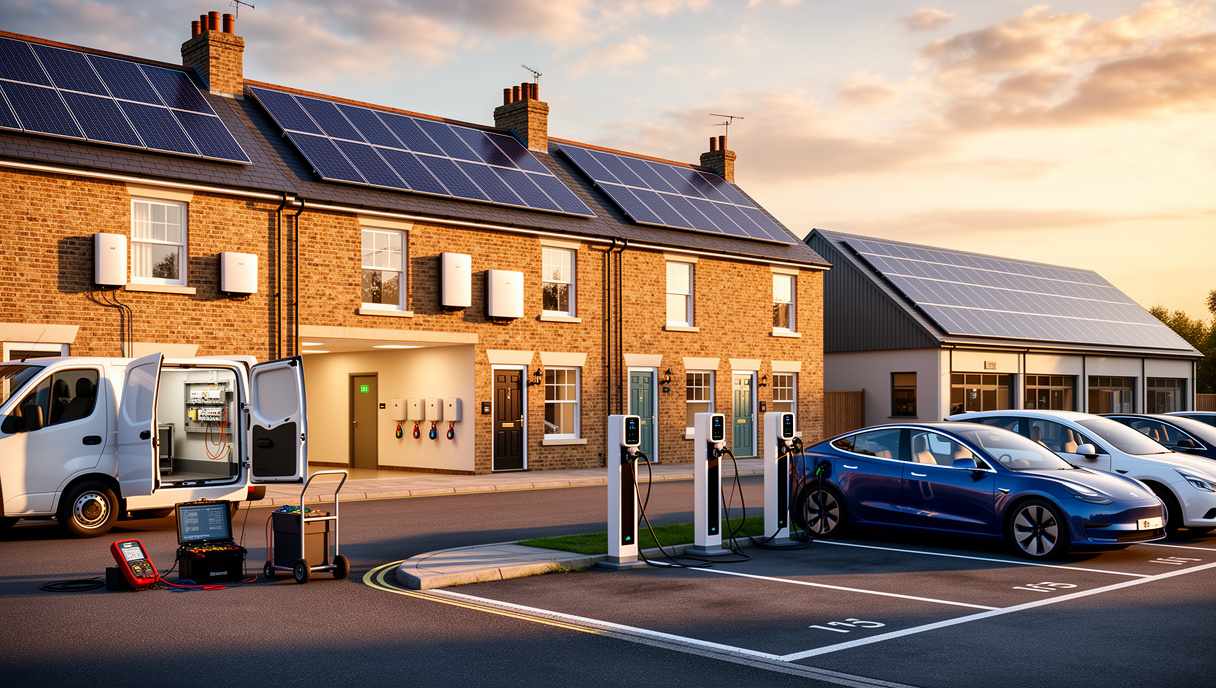
Smart add-ons help Bedford properties realise even more value. Pairing solar PV with an EV charger means a portion of vehicle mileage is powered directly by the sun, especially effective with scheduling and solar-matching features. Heat pump owners benefit from automations that pre-heat cylinders or buffer tanks when solar output is high. Batteries enhance resilience, and certain configurations can maintain essential circuits during outages—covering lighting, refrigeration, communications and home-working equipment. For buildings in conservation areas or with slate roofs, low-profile, all-black modules and sensitive mounting choices protect kerb appeal; for schools or community centres in places like Biddenham or Wixams, visible displays of live generation data support education and climate engagement. As a Bedford-based electrical contractor experienced in renewables, LB Electrical brings together compliant design, neat installation and ongoing support—tying solar, batteries and EV charging into a cohesive, future-ready system tailored to local needs.

Fukuoka bioinformatician road-tripping the US in an electric RV. Akira writes about CRISPR snacking crops, Route-66 diner sociology, and cloud-gaming latency tricks. He 3-D prints bonsai pots from corn starch at rest stops.